Showing posts with label Pets. Show all posts

Monday, January 11, 2016

Weight Loss In Your Pets

Lean dogs and cats live longer and healthier lives.  Many pet owners don’t notice their dog or cat gradually putting on extra weight until the animal starts slowing down significantly or until someone else points it out.  Some studies have shown that more than 45 percent of dogs and 58 percent of cats can be classified as overweight or obese.  While it may not seem like much to us, a gain of even a pound or two of additional fat on some dogs and cats can place significant stress on the body. 

Some of the effects of obesity can be reversed through diet changes and increased physical activity.  Unfortunately, there is some damage that is irreversible, and some that can only be mitigated by the change of habits.  The longer the excess weight is on the body, the more severe the long term damage to the body will likely be.

Some of the conditions that can occur as a result of excess weight are:
  • Hypertension (high blood pressure)
  • Heart issues
  • Diabetes
  • Liver disease or dysfunction
  • Osteoarthritis
  • Exercise intolerance
  • Breathing issues
  • Heat intolerance
  • Increased risk of developing cancer
There are ways you can check your pet to see if they are overweight.  Feel around their midsection while they are standing. The ribs and spine should be easy to feel, and on most pets there should be a slight hourglass shape to the waist. If you cannot easily feel your dog or cat’s ribs or spine, and the waist has thickened considerably enough to give the animal a more tubular shape than hourglass shape, it is time for you to consult with your veterinarian about a weight loss regimen for your pet.

There are a few underlying metabolic problems that can cause weight gain in your pet.  When diet and exercise just aren’t enough, it may be time to check for some of these health concerns.  A simple blood test can reveal whether a metabolic problem, such as an under-functioning thyroid, Diabetes, or Cushing’sDisease is to blame. In many cases, your dog is probably just eating too many calories and not exercising enough.

Record your pet's weight to establish a baseline and have your vet help determine an ideal weight for your pet.  Sometimes it is as simple as cutting their daily food portions, treats included, by about one-third.  It is important to make sure their food is nutritionally sound and that they won’t be deprived of a healthy and balanced diet by making this cut.  Your vet may also have you switch to a low-calorie pet food or one designed for weight loss. This way, your pet will be able to eat about the same amount they are accustomed to, but will still take in fewer calories. It is ok to still occasionally give your pets treats but it is important to calculate these additional calories into the daily calorie count.  Things such as fresh vegetables, lean cooked meats, and low calorie treats are acceptable treats for most pets.  A lot of times your pet will be just as happy with praise, patting, playful actions, a short walk, or a favorite toy.


Some examples of pet exercise include:


Some free time in a fenced in yard is usually not enough exercise for your pet.  Keep in mind that just like with people, your furry friend may tire quickly, especially if they are not accustomed to much more than lounging around the house. When first starting your pet on an exercise routine it is important to watch for any signs of overexertion including a slowed pace, panting, and sitting or lying down.

With deliberate eating habits and daily exercise, your pet should start losing weight in about two weeks' time. The key, for canines, felines, or humans, is to boost nutrition, lower calories and increase movement. It's as simple -- and difficult -- as that. Call us or schedule an appointment at Kaibab Animal Hospital to discuss a good reduced-calorie food and exercise plan that will specifically benefit your pet’s age, weight, and breed, and you will be on your way to getting your pet on the road to recovery before it is too late. The good news is that by working together, you can both enjoy a healthier lifestyle.

Thursday, December 17, 2015

15 Gift Ideas for Pets and Pet Lovers

The season for giving is here! If your cats or dogs have been resisting the temptation of an indoor tree full of shiny objects, we think that’s reason enough to land them on the “nice” list this year! Here are our top 15 gift ideas for the pets or pet lovers in your life:

1.  While you’re away the pets will play! We may think that to be true but more than likely they are snoozing the day away to pass the time until you return. Provide some entertainment and mental stimulation with a pet focused TV channel. Fair warning, you may have to play tug-of-war for the remote once they discover all the fun sights and sounds these channels have to offer. http://www.thepetnetwork.tv/   https://dogtv.com/

2.  Ever wish you could text your cat or dial your dog midday, you know, just to see how they are doing? No need to wait in line for the latest iPhone for Fido. Now you can see and speak to your pet thanks to some awesome technology! PetChatz is a videophone allowing you to interact with your dog or cat from just about anywhere! You can even dispense a comforting scent or treat.   http://www.petchatz.com/about/faqs/


3.  Give the gift of a superb customer and patient experience with a Kaibab Animal Gift Certificate! Purchase a certificate in any amount for the pet owners in your life to use towards our many available services.

4.  Coffee tables will be infinitely cuter with this canine-centric book, The Dogist. http://www.anthropologie.com/anthro/product/37651569.jsp#/

5.  These puzzles are great for the canine brain and provide mental stimulation for a well-balanced dog. They are perfect for hot summer days that restrict outdoor exercise. We are not ready to think of summer yet either but it doesn’t hurt to be prepared! http://www.amazon.com/Nina-Ottosson-Dog-Treat-Fighter/dp/B000XPCSAM/ref=sr_1_4?ie=UTF8&qid=1354138578&sr=8-4&keywords=nina+ottosson

6.  Our pets are part of the family! Keep them healthy all year long and save big with Kaibab’s Wellness Plans. We offer a feline and canine Basic Plans, Plus Plans, and Senior Plans. Each plan comes with numerous services for both preventative and illness care. Contact us via phone (480) 947-8113 or email Kaibabah@gmail.com to discuss which plan best meets your pet’s needs.

7.  Check out Purrfect holiday toys your cat is sure to love from the very stylish Haus Panther collection.  http://shop.hauspanther.com/collections/holiday


8.  Find inspiration and create a stylish and functional environment you and your feline friend are sure to adore with the help of this book by Animal Planet star Jackson Galaxy and Haus Panther designer Kate Benjamin. http://www.amazon.com/dp/0399166017/?tag=buzz0f-20

9.  Keep it sweet and simple with these tasty dog treats made locally right here in Arizona! http://www.happytailsbarkery.biz/product/apple-cinnapaw-fresh-breath-treats/

10.  This fetching set of mugs is sure to make any dog owner smile. We can all relate to these tricks. http://www.uncommongoods.com/product/bad-dog-wisdom-diner-mugs-set-of-4

11.  Heading out to a party or an evening with family? Bring some holiday cheer and share a bottle of wine that supports our friends and local organization, Lucky Dog Rescue. http://www.benefitwines.com/Lucky-Dog-Rescue_c_596.html

12.  So the saying goes, “Every dog has its day” but it looks like the year 2016 is going to the cat with this chic desk calendar. http://www.modcloth.com/shop/stationery/year-of-the-critter-2016-calendar-in-kitties?SSAID=595441&utm_medium=affiliate&utm_source=sas&utm_campaign=595441&utm_content=417942&gate=false

13.  Cats cannot seem to resist a cardboard box. Give them the Energy Pyramid for Cosmic Kitties. It is easily assembled, contains a scratching surface, and you can wipe it clean! http://www.modpetlife.com/energy-pyramid-cat-house-by-lovethybeast/

14.  Every good dog needs a place to put their toys! http://www.harrybarker.com/gifts/santa-toy-bucket.html

15.  Cherish your best buddy with this fun and easy kit. Create a personalized paw print ornament to treasure for all the holidays to come. http://www.amazon.com/Sculpey-Keepsake-Deluxe-Pawprint-Kit/dp/B002NHH6NM

Wednesday, December 9, 2015

Canine Influenza Update

Over the last few months, canine influenza (canine flu) has been an emerging disease that contributes to Canine Infectious Respiratory Disease Complex (CIRD Complex).  Here at Kaibab Animal Hospital we promised you that we would keep you updated and we have been monitoring this disease and the spread of it across the country.  Unfortunately, canine flu has found its way into Arizona and the indication is that the number of cases will only continue to increase in the coming months.  Cases have now been reported in Pima County and over a dozen cases here in Maricopa County too.  Because of this, Kaibab Animal Hospital has decided that it is now time to begin recommending the flu vaccine to all of our at-risk patients.  The two vaccines available, H3N8 and the newer H3N2, are given as an initial dose that needs to be boostered 2-4 weeks afterwards and then boostered annually thereafter.

Canine flu is not a seasonal disease like it is in people, so your dog is constantly at risk for contracting it.  Some breeds are more susceptible to the virus and the seriousness of the disease than others but on average, there is approximately an 8% mortality risk with this disease.  This means that up to 8% of dogs that contract canine flu may die from complications.  This number increases to near 30% in hound-breeds.  Though most dogs will survive the infection, the damage done to the lungs during the course of the disease is severe and permanent.  The two predominant strains of canine flu (H3N8 and H3N2) both have very effective vaccines that can prevent the disease from ever starting in your dog.

Does your dog:
  • Visit doggie Daycare?
  • Board at a boarding facility?
  • Attend training classes?
  • Play at dog parks?
  • Participate in dog-friendly events?
  • Attend dog shows or sporting events?
  • Visit a groomer or the local pet store?
  • Often greet other dogs during walks?


If you answered yes to any of these questions, your dog is at a higher risk for contracting canine influenza and vaccination is recommended.  Now that we are into the holiday season and boarding of dogs increases dramatically, your dog needs to be protected if they will be staying at a boarding facility.  Please call us to schedule an appointment and get your canine family member started with the initial vaccination in the series.

Wednesday, December 2, 2015

Why Take The Risk? Get Your Pet Microchipped

Image of dog with lost sign and blog title Why Take The Risk? Get Your Pet Microchipped


The thought of losing a pet is every owner’s worst nightmare. According to Maricopa Animal Care and Control’s 2014 Annual Report, only 11% of the 38,235 animals that entered the shelter were able to be returned to their owners. Luckily, there are steps we can take to increase the probability that a lost furry friend will be celebrating a joyful reunion.

Although a collar and tags are important, they can easily fall off or be removed. By electing to microchip your pet, you will have the most permanent form of identification working to protect your beloved dog or cat. Microchips insure a higher probability that your pet will be returned to you. 

Image of microchip size in comparison to grain of rice
Microchip compared to grain of rice.
Although a collar and tags are important, they can easily fall off or be removed. By electing to microchip your pet, you will have the most permanent form of identification working to protect your beloved dog or cat. Microchips insure a higher probability that your pet will be returned to you.

What is a microchip?

A microchip is about the size of a grain of rice. Each microchip is encased in bio-compatible glass and contains an actual chip that holds information and components that emit a radio frequency. A microchip is not a GPS device, nor does it actively transmit signals. A microchip is considered passive and only transmits a radio frequency when a scanner is waved within close proximity of the chip. 

How is the microchip inserted?

Microchipping may sound like an invasive procedure; however, it is very easy and routine. Microchipping a pet works just like a vaccination and does not require surgery or anesthesia.  A microchip is contained within a sterile needle on the end of a syringe device. Typically for a dog or cat, a chip is inserted just under the skin in between the shoulder blades.  The procedure is completed quickly and your pet will experience little to no pain very similar to vaccinations.

What do I do after my pet is microchipped? 

You have taken an important, proactive step to protect your pet but your job is not done just yet! A microchip is nearly useless if you do not complete the registration process. Each microchip comes with a unique ID code that is entered into the microchip manufacturer’s database. In order for a microchip to be effective, you must register the chip so that the ID code corresponds with your contact information.  It is also important that if you move or change your phone number that you update your records with the microchip registration company as well.

Many microchip companies charge a registration fee, so plan for the possibility of this cost which averages around $20.  Depending on where your pet is micro chipped, the registration fee may be covered in the implantation cost. Ask if there is an additional registration or annual fee you need to pay in order to ensure the chip will be a beneficial tool. It is important to research the various microchip companies, the fees involved, and the services they provide in order to find which brand is best for you and your pet.

It is a good idea to register with the manufacturer, but you can also register the chip with a universal database or elect this option instead. Two examples of universal databases are HomeAgain and PetLink.  Universal databases may offer additional services, including but not limited to, a 24/7 emergency hotline, lost pet guidance, lost pet alerts,  travel assistance for pets found far from home,  microchip tags for the collar, online search, and direct connection to the finder of your pet.
If you cannot afford the fees that often come with some of these databases, consider utilizing Free Pet Chip Registry.  This company is working to become a universal and free database for microchip registration.  

How is a microchip read?

Image of person using microchip scanner wand over dog's back between shoulder blades.
Microchip scanner.
A microchip is read using a scanner. Vets, shelters, clinics, and many police and fire stations have scanners which they wave over the pet’s body. If a chip is present, the scanner will initiate and read the radio frequency of the chip and the assigned ID code will appear on the screen. Codes are categorized by microchip companies. The corresponding company is then contacted to look up owner information within their database. General databases can also be used to search for owner information and  may cover multiple brands.

If your chip is registered and up to date, the company will be able to contact you and inform you where your pet is and who to contact to retrieve your pet. Micro chipping greatly increases the chances of pet recovery, especially when a collar and tags can fall off or be removed. 

How can I be a proactive owner?
·         
        If registration is offered through your veterinarian, clinic, or shelter: call the database company to verify your information is entered correctly and verify their terms of service.
·         Keep a record of your pet’s microchip number, the contact information for the manufacturer and the database the chip is registered in. Provide a record for your regular veterinarian if the pet was not chipped at their office. Always leave this information with a family member, boarding facility, or pet sitter if you are traveling away from your pet.
·         Update your information anytime you move or change your phone number. If you register an emergency contact, ensure this information is up to date as well.
·         Have your vet or clinic scan your pet’s chip once a year to ensure effectiveness.

Where can I get my pet micro chipped and how much will it cost?

If you have a veterinarian, call and ask about their microchips to find out the manufacturer and cost. Always ask if registration is included and if the company they use charges annual fees as prices can vary.

Call Kaibab Animal Hospital at (480) 947-8113 today for an appointment to get your pet microchipped. We use HomeAgain microchips and include a tag for your pet’s collar as well as registration.  If you have additional questions or concerns, please do not hesitate to give us a call and one of our staff members will be happy to assist you. 

We are open Monday through Friday 7:00 AM to 7:00 PM, Saturdays from 8:00 AM to 2:00 PM and Sundays 11:00 AM to 3:00 PM. Kaibab Animal Hospital is located at 3010 North 68th Street Scottsdale, AZ 85251. 

Thursday, November 12, 2015

Dog Parks Around Kaibab Animal Hospital

Now that the weather has started to cool down, it’s the perfect time to take your dogs out and let them get some exercise.  While walking your dogs around the neighborhood is a great way to get them (and you) moving, sometimes a change of scenery is fun.  Municipal dog parks make that change very easy and convenient.  If you have a friendly, well-socialized dog that is also healthy and current on vaccinations, then a dog park may be a great option for you.

There are many dog parks scattered around the Phoenix metropolitan area but today we will explore some that are just a few miles away from Kaibab Animal Hospital.

                              1.  Chaparral Park
                             5401 N Hayden Rd, Scottsdale, AZ 85250


Chaparral Park is a beautiful recreational area that has long walking trails, ramadas for picnics, and lakes where you can enjoy watching ducks.  Dogs love exploring the entire park but there is also an off-leash section where your dog can run, play, and burn off energy with friends.  The off-leash area is separated into ‘active dog’ and ‘passive dog’ areas so that all personalities have a chance to play and explore with similar dogs.


2.  Vista del Camino Park
                             7700 E Roosevelt St, Scottsdale, AZ 85257


Vista del Camino Park is another beautiful place along the Scottsdale Greenbelt.  Similar to Chaparral, there are long walking trails, ramada’s, and a lake.  The off-leash area is higher on a hill in the corner of the park, overlooking the children’s playground.  The park is on the smaller side and is generally less active so it may be a better option for some pets who are overwhelmed in the larger parks.

3.   Creamery Park
     1520 E 8th St, Tempe, AZ 85281


Creamery Park is named for a dairy business that originally opened in 1892 and was one of the largest employers in Tempe for many years.  It’s close to ASU and it is perfect for a relaxing time for students wanting to get away from their studies for a bit.  The off-leash area is on the smaller side but has trees and an area for you to sit while you watch your dog enjoy running and playing in the sun.


4.  Mitchell Dog Park
           900 S Mitchell Dr, Tempe, AZ 85281


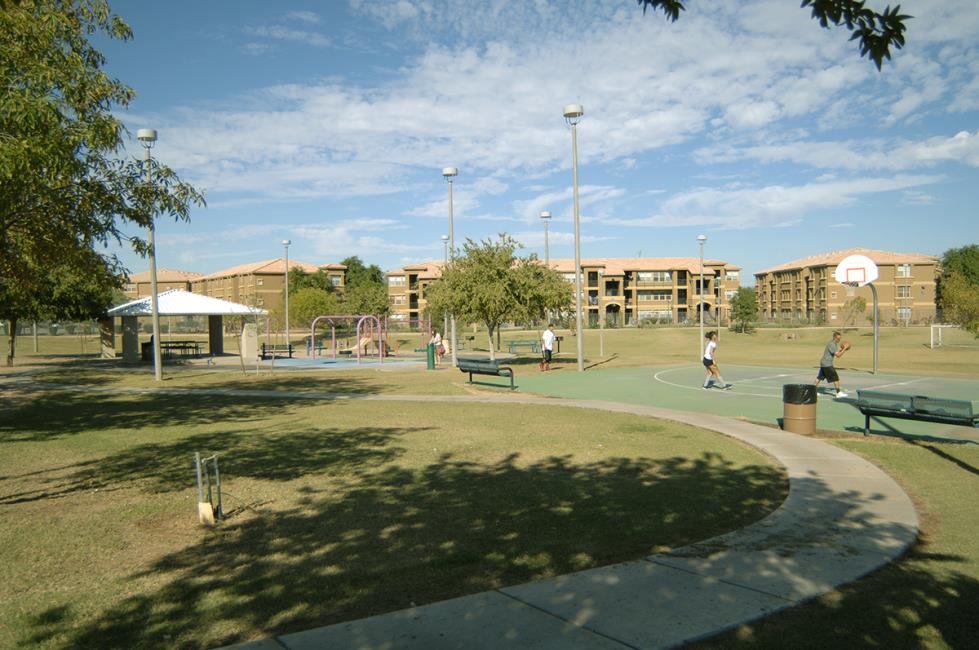
Mitchell Dog Park is another smaller park in the area of ASU and is surrounded by a cute little neighborhood.  For the humans, the park has large grassy areas, soccer fields, and basketball courts.  The off-leash area is not usually over-crowded but there are enough dogs to allow for play and socialization time.  While your dog is running around making new friends, there are trees for shade and benches for you to relax on and enjoy the surrounding area.

5.  Jaycee Park
           817 W 5th St, Tempe, AZ 85281


Located just a few blocks away from Mitchell Dog Park, Jaycee offers very similar amenities for entertainment but also boasts a splash pad for the kids (or kids at heart) and a  community center.  The off-leash area is smaller and more intimate than some of the other parks but the seating areas with shade make it a great place to let your dog run free while you enjoy a nice lunch in the fresh air.


Off-leash parks can be a great way for an active, friendly, and well-socialized dog to burn some energy and make great friends.  Many of our clients love going to the parks and tend to go at the same times each week so that their dogs can build friendships with the other dogs.  Watching your beloved pet get excited as they run up to their ‘pack’ and jump and play endlessly is an easy way to bring a smile to your face!